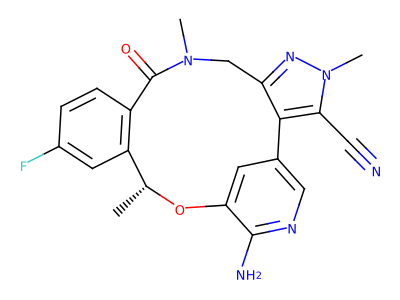
|
| ID |
DDInter1094 |
| Drug Type |
small molecule |
| Molecular Formula |
C21H19Fn6O2 |
| Molecular Weight |
406.421
|
| Description |
Lorlatinib has been used in trials studying the basic science and treatment of Non-small Cell Lung Cancer and anaplastic lymphoma kinase (ALK)-positive Non-Small Cell Lung Cancer (NSCLC) and ROS1-positive NSCLC. Despite initial responses from the use of various ALK inhibitors, however, it is virtually almost guaranteed that all patients with the condition in question will develop tumour progression or resistance to the current therapy in use [A40086].
Considered a third-generation ALK tyrosine kinase inhibitor (TKI) for patients with ALK-positive metastatic NSCLC, lorlatinib's most optimal place in the treatment sequence of this condition has most recently been identified with its latest approval by the US FDA in November of 2018 for the indication of treating those patients' disease which has progressed even after the use of first and second-generation TKIs like crizotinib, alectinib, or ceritinib [L4848, FDA Label]. Loratinib's ability to move past the blood-brain barrier facilitates its ability to treat progressive or worsening brain metastases as well [L4848, A40078].
|
| ATC Classification |
L01XE44
|
| IUPAC Name |
(16R)-19-Amino-13-Fluoro-4,8,16-Trimethyl-9-Oxo-17-Oxa-4,5,8,20-Tetraazatetracyclo[16.3.1.0^{2,6}.0^{10,15}]Docosa-1(22),2,5,10( |
| InChI |
Inchi=1S/C21H19Fn6O2/C1-11-15-7-13(22)4-5-14(15)21(29)27(2)10-16-19(17(8-23)28(3)26-16)12-6-18(30-11)20(24)25-9-12/H4-7,9,11H,10H2,1-3H3,(H2,24,25)/T11-/M1/S1 |
| InChI Key |
IIXWYSCJSQVBQM-LLVKDONJSA-N |
| Canonical SMILES |
C[C@H]1OC2=C(N)N=CC(=C2)C2=C(C#N)N(C)N=C2CN(C)C(=O)C2=C1C=C(F)C=C2 |
| Useful Links |
DrugBank
ChEMBL
|